Showing posts with label Military. Show all posts

Tuesday, September 25, 2012

US China expert Kenneth Lieberthal criticises Japan


Kenneth Lieberthal is talking in riddles. Some say he is quoted out of context by the Chinese media. Others thought that he was speaking with a conscience. Or was this a Freudian slip? 

China's economic and military leverage has certainly strengthened in recent years. 

Unlike most who sided with Japan recently, Lieberthal ought to know the history well. Japan's acquisition of the islands was a gift on the silver platter from American troops at a time when China was weak and rebuilding the country, unable to resist losing its territories to aggressors. 

Japan and its supporters cannot change the facts that the islands were under Chinese jurisdiction during the Ming dynasty with documented evidence and the recognition accorded by the Cairo Declaration and the Potsdam Declaration.   

If Japan indeed believes that it has a strong case, it would not need to posture, nationalise or buy up the Diaoyutai islands. Whether by historical or territorial boundaries, Japan lacks ammunition to stake claims, except with its loud complaining voice and encouragement of its military ally. It is orchestrated with the Philippines and Vietnam to exert pressure on China when it's vulnerable during leadership change.

Japan broke consensus with China on Diaoyu Islands
Updated: 2012-09-21  
WASHINGTON - The Japanese government's bid to "nationalizethe Diaoyu Islands hadbroken its consensus with China to shelve the territorial disputea US expert said Thursday. 
"First of allI think that Japan's actions have been key in explaining what China has done," saidKenneth Lieberthala senior fellow at the Brookings Institution who had been the seniordirector for Asia at the National Security Council in the Clinton administration.
Speaking at a symposium at the Washington-based think tankhe also admitted it was a "hugemistakewhen US government officials made comments that suggested Washington did have aposition on the dispute. 
"I think that does us no goodAnd occasionallysome comments like that have come out,"Lieberthal said. "I think that they are regrettable."


http://www.chinadaily.com.cn/world/2012-09/21/content_15774792.htm

http://www.bloomberg.com/video/63260542-brookings-s-lieberthal-interview-on-china-s-diplomacy.html

Nevertheless, China should not, has not and would not throw away what its hard won respect and gains built up over the years through diplomacy.  As we write, both countries are holding consultations. Clearly escalation would neither benefit China nor Japan. 

The onus is really on Japan to resolve the crisis fairly. This is unlikely with a right-wing domination of the Japanese government bent on militarising bilateral issues at the expense of economic benefits and regional stability. However, China unlike the US does not partake in regime change around the world. 

http://news.xinhuanet.com/english/china/2012-09/25/c_131872241.htm


Saturday, June 2, 2012

Secret war chapter missing in the public version of Australia's defence white paper


Who wants to fight a war? 

Not surprising, there are some who may benefit from wars. 

That's what the hushed up section of the defence white paper issued during PM Kevin Rudd's leadership. This was revealed in  a new book, The Kingdom and the Quarry: China, Australia, Fear and Greed.  

The Australian military establishment, like that of the US and other countries, have an interest in lobbying for increase defence spending against a played up enemy. Force 2030 set out in the white paper was to acquire 12 big conventional submarines with missiles, revolutionary Joint Strike Fighters, air warfare destroyers and giant landing ships to prepare for possible war with Australia's main trade partner. 

Unfortunately, it is dangerous weapons, human lives and properties that warmongers are toying with. It seems much easier to create enemies than enhance friendly relations in the post-Cold War era. 

Consistent with the overall strategic policy is reliance on close friendship with US at whatever costs. However, the contagion of global economic woes and other economic priorities has put pressure on the Gillard government to cut defence spending. 

http://www.theaustralian.com.au/national-affairs/foreign-affairs/secret-war-with-china-uncovered/story-fn59nm2j-1226381002984

"  A new book, The Kingdom and the Quarry: China, Australia, Fear and Greed, reveals how Force 2030 set out in the white paper - to include 12 big conventional submarines with missiles, revolutionary Joint Strike Fighters, air warfare destroyers and giant landing ships - was being prepared for a possible war with Australia's main trading partner.
In the lead-up to the release of the paper in May 2009, The Australian reported extensively on the debate among Australia's security and intelligence agencies over whether China was likely to pose a threat as it increased investment in its armed forces.
The public version of the paper stopped short of declaring that war with China was what the authors feared. To avoid offending the Chinese, and to create a degree of deniability, discussion of possible future conflict relied on euphemisms such as a "major power adversary".

 Even the sanitised public version of the white paper was enough to upset the Chinese. They asked Mr Pezzullo to revise the description of the regional security environment and, in particular, the references to China's military modernisation.

The Beijing media said the white paper was a victory for the "hawks" in Australia's defence establishment and that was partly because Mr Rudd wanted to show himself to the electorate as tough on China, to show loyalty to the US and to give Australia an excuse to increase its forces."

Thursday, April 19, 2012

India escalates tension and shows aggressive posture with intercontinental missile tests

India's military buildup is uncalled for. It is clear as day who is the hostile party. 


China, on the other hand, tries to play down the threat and calm fears.  However, we know that China is only putting up a confident front. The motivations of one's neighbour in showing its military capability and war readiness are of serious concerns. 


Why didn't India's aggressive posture draw the same criticisms and objections from western powers?   For instance, Iranian acquisition of nuclear capability pre-weapons manufacture and North Korea's failed attempt.


US has been providing both political and technological support (hedging its bets against Pakistan turning). However, we have learnt dearly that wars do not help to end wars. 


http://www.reuters.com/article/2012/04/19/india-missile-idUSL3E8FJ1KZ20120419

http://www.channelnewsasia.com/stories/afp_asiapacific/view/1196249/1/.html

Quote :

Beijing on Thursday downplayed India's successful launch of a missile capable of striking anywhere in China, saying the neighbouring giants were not rivals.

India earlier on Thursday test-fired its new Agni V missile, which boasts a 5,000-kilometre (3,100-mile) range and is capable of delivering a one-tonne nuclear warhead.

"China has taken note of reports of India's missile launch," foreign ministry spokesman Liu Weimin told reporters when asked for comment on the launch.

"China and India are both big emerging countries, we are not rivals but cooperation partners."

Analysts have noted the Agni V extends India's missile reach over all of China, including military installations in the far northeast.


http://bbs.chinadaily.com.cn/thread-743246-1-1.html

Quote


Only the permanent members of the UN Security Council - China, Russia, France, the United States and the United Kingdom - along with Israel, are believed to have such long distance missiles.

The launch will be closely monitored by India's nuclear-armed rivals China and Pakistan and by Western countries, but is unlikely to draw the kind of criticism aimed at North Korea after its own failed long-range rocket launch on Thursday.

India has a no-first-use policy and says its nuclear weapons and missiles are for defensive purposes only.

Monday, January 30, 2012

China's Military Expenditure : world's second largest economy is also second largest military spender

World military expenditure in 2010 is estimated to have been $1630 billion, an increase of 1.3 per cent in real terms.* The region with the largest increase in military spending was South America, with a 5.8 per cent increase, reaching a total of $63.3 billion, according to new data published today by Stockholm International Peace Research Institute (SIPRI). 

http://www.sipri.org/media/pressreleases/2011/milex

http://www.defpro.com/daily/details/949/?SID=99d7114acb063f540d64adc2b9784868


Asia is not supposed to catch up with western countries in economic development and defence expenditure!
Arms race is a bad thing. Only the developed countries are entitled to protect their territorial integrity and  vital global economic interests including expansionism.

http://www.globalissues.org/print/article/75

While it is fine for US and NATO to encircle Russia and China since the Cold War, South America is out of bounds to non-so-friendly foreign powers (Cuban Missile Crisis) and independent-minded regimes governed by "despots" and "autocrats".

It would really be strange for western economies dogged by bankruptcy and successive crises to continue spending. They should sell their arms to earn some cash.  Don't be mistaken. The US is still the largest military spender in the world.

The fear is that "irresponsible" and "undemocratic" governments would be misusing their military acquisitions to threaten western interests. A more worrisome trend is emerging powers fighting amongst themselves, whether for selfish gains or as proxies, would bring about misery and major catastrophes to their innocent populations.

Wednesday, December 7, 2011

Sino-Indian border disputes and US encirclement of China, Australian uranium exports and continuation of deceptive and deluded foreign policies

Sino-Indian border disputes

Despite availability of documents and first hand revelations by insiders, many still did not know that India started the Sino-Indian border clash in 1962 with the help of western powers.

An Australian diplomat (Gregory Clark) then knew the truth and did the right thing. However, he forced was forced to carry out orders from seniors in foreign office to perpetuate myths and lies of Chinese aggression in the Sino-India border dispute 40 years ago.

The facts are :

- China was protecting its territorial integrity in the dispute.

" ... both the Dho La Strip and the Thag La Ridge were indeed north of where the McMahon Line was supposed to be. In which case, India was clearly the aggressor." 

- China aggressor label / image propaganda was part of the US/NATO/ west Cold War gameplan

- Tibet was the front to Nehru's nationalistic frontier policy

References :

Gregory Clark, Remembering a War - the 1962 India China Conflict (Landsdowne  )
http://gregoryclark.net/redif.html

Nevill Maxwell, India's War with China (1972)

Australian uranium exports

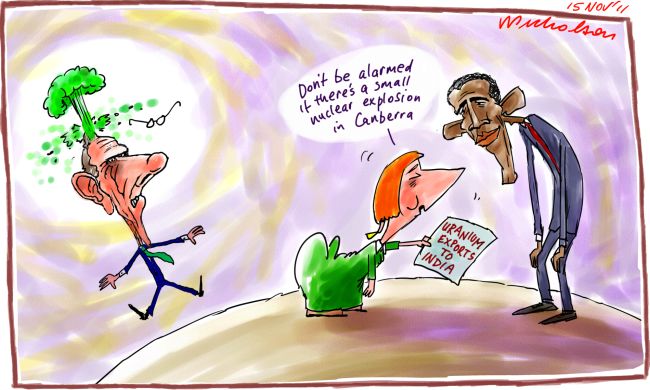
Some governments (Australia in this case) however do not learn from past mistakes nor do they foresee the dangerous of nuclear arms race and risk of war that would end mankind / humanity. This has created controversy not only in the region but domestically in Australia.

The ban to export uranium to India has been lifted supposedly as a check to China's growing power in the region. But given the irresponsible, dishonest and expansionist tendencies of some states, this is not a wise move. It will also encourage more states, such as Islamist terrorist infested Pakistan, to seek lifting of uranium ban to boost its nuclear power vis-a-vis India.

http://www.bbc.co.uk/news/world-asia-16027509
http://www.economist.com/node/9687637?story_id=9687637
http://news.xinhuanet.com/english2010/world/2011-12/04/c_131287540.htm


Monday, November 21, 2011

China's Humanist Approach to Long-term Victory

How China Can Defeat America


by Yan Xuetong

Quotes :

The key to international influence was political power, and the central attribute of political power was morally informed leadership. Rulers who acted in accordance with moral norms whenever possible tended to win the race for leadership over the long term.


According to the ancient Chinese philosopher Xunzi, there were three types of leadership: humane authority, hegemony and tyranny. Humane authority won the hearts and minds of the people at home and abroad. Tyranny — based on military force — inevitably created enemies. Hegemonic powers lay in between: they did not cheat the people at home or cheat allies abroad. But they were frequently indifferent to moral concerns and often used violence against non-allies. The philosophers generally agreed that humane authority would win in any competition with hegemony or tyranny.


Unfortunately, such views are not so influential in this age of economic determinism, even if governments often pay lip service to them. The Chinese government claims that the political leadership of the Communist Party is the basis of China’s economic miracle, but it often acts as though competition with the United States will be played out on the economic field alone. And in America, politicians regularly attribute progress, but never failure, to their own leadership.
Both governments must understand that political leadership, rather than throwing money at problems, will determine who wins the race for global supremacy.
How, then, can China win people’s hearts across the world? According to ancient Chinese philosophers, it must start at home. Humane authority begins by creating a desirable model at home that inspires people abroad.
This means China must shift its priorities away from economic development to establishing a harmonious society free of today’s huge gaps between rich and poor. It needs to replace money worship with traditional morality and weed out political corruption in favor of social justice and fairness.
In other countries, China must display humane authority in order to compete with the United States, which remains the world’s pre-eminent hegemonic power. Military strength underpins hegemony and helps to explain why the United States has so many allies. President Obama has made strategic mistakes in Afghanistan, Iraq and Libya, but his actions also demonstrate that Washington is capable of leading three foreign wars simultaneously. By contrast, China’s army has not been involved in any war since 1984, with Vietnam, and very few of its high-ranking officers, let alone its soldiers, have any battlefield experience.
America enjoys much better relations with the rest of the world than China in terms of both quantity and quality. America has more than 50 formal military allies, while China has none. North Korea and Pakistan are only quasi-allies of China. The former established a formal alliance with China in 1961, but there have been no joint military maneuvers and no arms sales for decades. China and Pakistan have substantial military cooperation, but they have no formal military alliance binding them together.
To shape a friendly international environment for its rise, Beijing needs to develop more high-quality diplomatic and military relationships than Washington. No leading power is able to have friendly relations with every country in the world, thus the core of competition between China and the United States will be to see who has more high-quality friends. And in order to achieve that goal, China has to provide higher-quality moral leadership than the United States.
China must also recognize that it is a rising power and assume the responsibilities that come with that status. For example, when it comes to providing protection for weaker powers, as the United States has done in Europe and the Persian Gulf, China needs to create additional regional security arrangements with surrounding countries according to the model of the Shanghai Cooperation Organization — a regional forum that includes China, Russia and several central Asian countries.
And politically, China should draw on its tradition of meritocracy. Top government officials should be chosen according to their virtue and wisdom, and not simply technical and administrative ability. China should also open up and choose officials from across the world who meet its standards, so as to improve its governance.
The Tang dynasty — which lasted from the 7th century to the 10th and was perhaps China’s most glorious period — employed a great number of foreigners as high-ranking officials. China should do the same today and compete with America to attract talented immigrants.
OVER the next decade, China’s new leaders will be drawn from a generation that experienced the hardships of the Cultural Revolution. They are resolute and will most likely value political principles more than material benefits. These leaders must play a larger role on the world stage and offer more security protection and economic support to less powerful countries.
This will mean competing with the United States politically, economically and technologically. Such competition may cause diplomatic tensions, but there is little danger of military clashes.
That’s because future Chinese-American competition will differ from that between the United States and the Soviet Union during the cold war. Neither China nor America needs proxy wars to protect its strategic interests or to gain access to natural resources and technology.
China’s quest to enhance its world leadership status and America’s effort to maintain its present position is a zero-sum game. It is the battle for people’s hearts and minds that will determine who eventually prevails. And, as China’s ancient philosophers predicted, the country that displays more humane authority will win.
Full article : 
http://www.nytimes.com/2011/11/21/opinion/how-china-can-defeat-america.html?_r=1

Wednesday, November 16, 2011

Rhetoric and Double Talk : Obama says US does not fear China - Action speaks louder than words, reassurance does not help to assuage excluded and irritated China's fear of reigniting Cold War

The logical thing for the US Administration and any government in dire economic straits is to cut budget, withdraw troops, turn ammunitions into economic capital, and focus on getting the economy out of the doldrums. But no, Obama has not lived up to expectations. He is desperate to prove to his political opponents and some American voters that he is hawkish and means business (in the military sense). Start a fire in your competitor's backyard and pretend that you mean no harm and act surprised that neighbours are alarmed. American Presidents have not learned from lessons in history when they have no qualms about bringing on the Cold War! 


Dictating terms and playing patron to another developing country is not new in US policy. Unfortunately, US has not been exemplary in its observance of international rules and norms, nor paying its fair dues.

Quote :

... the United States would deploy 2,500 Marines in Australia to shore up alliances in Asia, but the move prompted a sharp response in Beijing, which accused Mr. Obama of escalating military tensions in the region.


The agreement with Australia amounts to the first long-term expansion of the American military’s presence in the Pacific since the end of the Vietnam War. It comes despite budget cuts facing the Pentagon and an increasingly worried reaction from Chinese leaders, who have argued that the United States is seeking to encircleChina militarily and economically.
“It may not be quite appropriate to intensify and expand military alliances and may not be in the interest of countries within this region,” Liu Weimin, a Foreign Ministry spokesman, said in response to the announcement by Mr. Obama and Prime Minister Julia Gillard of Australia.
Some analysts in China and elsewhere say they fear the moves could backfire, rsiking a Cold War-style standoff with China.
The United States will not build new bases on the continent, but will use Australian facilities instead. Mr. Obama said that Marines will rotate through for joint training and exercises with Australians, and the American Air Force will have increased access to airfields in the nation’s Northern Territory.

Analysts say that Chinese leaders have been caught off guard by what they view as an American campaign to stir up discontent in the region. China may have miscalculated in recent years by restating longstanding territorial claims that would give it broad sway over development rights in the South China Sea, they say. But they argue that Beijing has not sought to project military power far beyond its shores, and has repeatedly proposed to resolve territorial disputes through negotiations.
The United States portrays itself as responding to a new Chinese assertiveness in the region that has alarmed core American allies. Secretary of State Hillary Rodham Clinton wrote a recent article in Foreign Policy laying out an expansive case for American involvement in Asia, and Defense Secretary Leon E. Panetta characterized China’s military development as lacking transparency and criticized its assertiveness in the regional waters.
Mr. Obama reached out to China even as he announced the new troop deployment. “The notion that we fear China is mistaken; the notion that we are looking to exclude China is mistaken,” he said.
The president said that China would be welcomed into the new trade pact if Beijing was willing to meet the free-trade standards for membership. But such standards would require China to let its currency rise in value, to better protect foreign producers’ intellectual property rights and to limit or end subsidies to state-owned companies, all of which would require a major overhaul of China’s economic development strategy. 

http://www.nytimes.com/2011/11/17/world/asia/obama-and-gillard-expand-us-australia-military-ties.html

Encirclement of China - boost democratic India's nuclear capability with Australian uranium heightens risks and tensions

It does not stop at granting US "presence" ("bases"?) in Darwin.

To please its US ally, PM Julia Gillard risks bringing the world closer to a nuclear war and her political standing within her own Labour Party, Greens and anti-nuclear lobby.

More hawkish displays - the world will not be safer with gunho policeman patrols in peaceful neighbourhood of hungry folks trying to make a decent living.


Quote


PRIME Minister Julia Gillard's push to sell uranium to India has triggered a fight with her party's Left, attracted disquiet from Pakistan and infuriated Foreign Minister Kevin Rudd, who was not consulted about the change.

But union official and Right powerbroker Joe de Bruyn, who raised objections to Indian uranium sales when the policy change was first proposed by Mr Ferguson, signalled he would support the PM's line. He said safeguards would be important, and he was sure they would be part of the policy change.
Australian Workers Union secretary Paul Howes called for the party in Western Australia and Queensland to ''overturn
their ideologically based and decades-old ban on uranium mining''. But Queensland Premier Anna Bligh said she would not be lifting the ban.

Jia Qingguo, associate dean of Peking University's Centre for International Relations, said Australia resuming uranium exports to India and establishing a US military presence in Darwin was part of an Obama administration strategy to balance perceived threats from China.
''There is a high probability that the Indians are not going to use the uranium for nuclear energy,'' he said.
''This is going to be counter-productive. When you encourage nuclear proliferation to your friendly countries it is very difficult to rein in nuclear proliferation to countries you don't like,'' said Professor Jia.

Read more: http://www.smh.com.au/national/gillards-uranium-backlash-20111115-1nhdh.html#ixzz1dvD3F8C2

http://www.smh.com.au/national/gillards-uranium-backlash-20111115-1nhdh.html

From blunt capitalist-imperialist US President Obama : Play by the Rules even if we break them - teaching an ancient peaceful civilisation restraint defies common sense

Obama is under immense pressure as his precarious standing becomes more obvious as the presidential re-election nears. His belligerent attitude and proactive alignment with Asia Pacific ally Australia defies rationality. Despite rhetoric for change, Obama has succumbed to neo-Cons to put on an aggressive cowboy front to stir up peaceful waters in the region. While China has thousands of years of diplomacy and peaceful coexistence even at the zenith of the Tang and Ming dynasties, post-war US has seen more invasions in distant lands, resulting in painful casualties and fatalities on all sides (not to mention mammoth economic losses),  within half a century. More than any other imperialistic and hegemonistic nations had chalked up in history. 


As long as US continues its ranting on China's currency manipulation instead of reflecting on and redressing weaknesses in domestic economic fundamentals, it is not getting out of the rut. There are lots of hard work to be done to curb its credit manipulation, raise fiscal standards, improve productivity and bring about more equitable distribution of wealth. Carbon trading and taxes are not on the US government's agenda either, preferring to put the blame and burden on Third World countries trying to pick up from lost years of development to eradicate poverty by sacrificing their health and environment taking on the role as factories of the world. 

Quote :


Obama's tough-minded and bluntly worded message to China was that rising power brings with it rising responsibilities. China has an obligation not only to follow the rules, but, in Obama's words, to help underwrite them.
Obama's comments were in answer to a question about trade. But his bluntness with China reflects a deep disappointment in Washington with China's performance over a wide range of economic, security and global governance issues.
The Trans-Pacific Partnership is not designed to exclude China, Obama says, but if a country wants to join it has to open up its economy. This is shrewd diplomacy by Obama. The TPP is open to any nation that meets the criteria. Because China won't meet the criteria, the emphasis of the discussion is not on the US beating up on Beijing, but Beijing's refusal to liberalise.


http://www.theaustralian.com.au/national-affairs/opinion/blunt-diplomacy-a-shrewd-move/story-e6frgd0x-1226197235738?from=promo-strip-na

Monday, May 23, 2011

General Liu Yuan says : read Zhang Musheng's "Changing our cultural history perspective"

Critics who alleged that Liu Yuan is sabre rattling obviously did not bother to read his "preface" to the book published by his social commentator friend Zhang Musheng some four years ago. Nor do they have any knowledge, understanding or appreciation of Chinese history.

Liu has certainly caught international attention though not in a favourable light. Bold imagery indeed but it is meant to wake the Chinese people from their slumber, not to alarm the insecure countries that are always on the lookout for pretext to brand China as expansionist.

Interestingly, a few pages penned by Liu whose main intention was to encourage readers to "savour" Zhang's collection of essays by Chinese thinkers could send shockwaves worldwide and spin wild speculations of China's rising militarism and leadership split!


A quick preview and gist of Liu Yuan's comments :
Liu rejects transplanting western democratic model into China as it will backfire. China should grow and embrace its unique and indigenous form of new democracy(similar to what his father Liu Shaoqi and Deng Xiaoping promoted).

History has shown that American, Japanese and Soviet systems were detrimental and could egulf China. The examples of Yugoslavia, Singapore and Hungary are only quick-fix potions. China should continue evolving and reforming itself with courage.


Indeed, people of China or the world for that matter, should not forget thousands of years of history. The reasons why the communist revolution took place was to unify the country, get rid of inequality, corrupt officials and foreign invasion and plunder. Life for the poor Chinese masses was difficult and untenable.

China has succeeded in feeding and clothing the starving millions and poor. However, economic growth based on the capitalist model has also contributed to the widening gap between the wealthy and poor, the coastal cities and remote provinces. Lest the Chinese forget and throw away all the hardwon gains from bloodshed and sacrifices through the revolutionary and reform years, the book is a timely reminder and stimulus for positive national action.  


Zhang is also known to be critical of corruption and ill discipline of some Chinese communist cadres. Does this mean that Liu implicitly or tacitly favours eradicating self-serving and bribe taking officials?

General Liu is a nationalist, like many Chinese. However, his outspoken style is not typical of Chinese leaders who are too polite and submissive. 

So, before anyone gives their two cents worth, go read the originals.
I'll be back with the full translation and informed analysis.